lundi 25 novembre 2013

Shrinking ecumene affects wealth

The early French geographers developed the theory of "possibilism" according to which one "la nature propose, l'Homme dispose", in English, "Nature purpose, human dispose of". People have elaborated some livelihoods which permit them to get some incomes from their environments and through which ones their have modified the landscapes.

However, because of the shrinking ecumene, desertification and sea level rise, people living next to the shore and on the side of the deserts are currently facing some changes in their environments. Their livelihood are less and less adapted to their new environments affecting their incomes and increasing the outputs. Bestelmeyer (2005) states that desertification affects human productivity. Indeed, the shrublands do not feed the livestock as much as the grasslands do. Moreover, Kulpraneet (2013) has assessed the adaptation cost of some Thailandese coastal household to more than 345 000 Bath for the next 30 years. This cost represents more than 150% of the GDP ppp per capita of the year 2010. For these populations, the sea level rise represent an important over-cost. As much as money which will not be invested, as much as investments which will not give any incomes. Shrinking ecumene affects wealth.

Therefore, where the ecumene is shrinking the incomes are decreasing. In opposition with the inhabitants of the small State Islands, most coastal population are not suddenly affected by these slow process. They are affected but do not appears as direct environmental refugees. However, their decreasing incomes could motivate the young generations to move for some higher financial gains. Already, because of the decreasing productivity of the Malian Sahel there is a growth of the youngest generations' mobilities (Sauvin-Dugerdil, 2013). Moreover, even if Bailey (2010) underlines that the "global south" is more affected by the climate-change, he states that some migrations are motivated in USA by the growth of insurances costs where the sea level rises become serious. These people, do not appear as "climate refugees", but their mobilities are the consequence of the global environmental change. This could answer the question of Fred Pierce (2011) in his article Searching for the climate refugees, "where are the climate refugees?". 

Bibliography: 

Bestelmeyer, B.T. 2005. Does desertification diminish biodiversity? Enhancement of ant diversity by shrub invasion in south-western USA. Diversity and Distribution. No. 11. p45-55

Bailey, A.J. 2010. Population Geography and Climate Change. Progress in Human Geography. No.35. Vol.5. p686-695

Kulpraneet, A. 2013. Coastal household adaptation cost requirements to sea level rise impacts. Mitig Adapt Strateg Glob Change. No.18. p285–302

Pearce, F. 2011. Searching for the climate refugees. NewScientist. No.2810

Sauvin-Dugerdil, C. 2013. Youth mobility in an isolated Sahelian population of Mali. The Annals of the American academy of political and social sciences. No.648 

lundi 18 novembre 2013

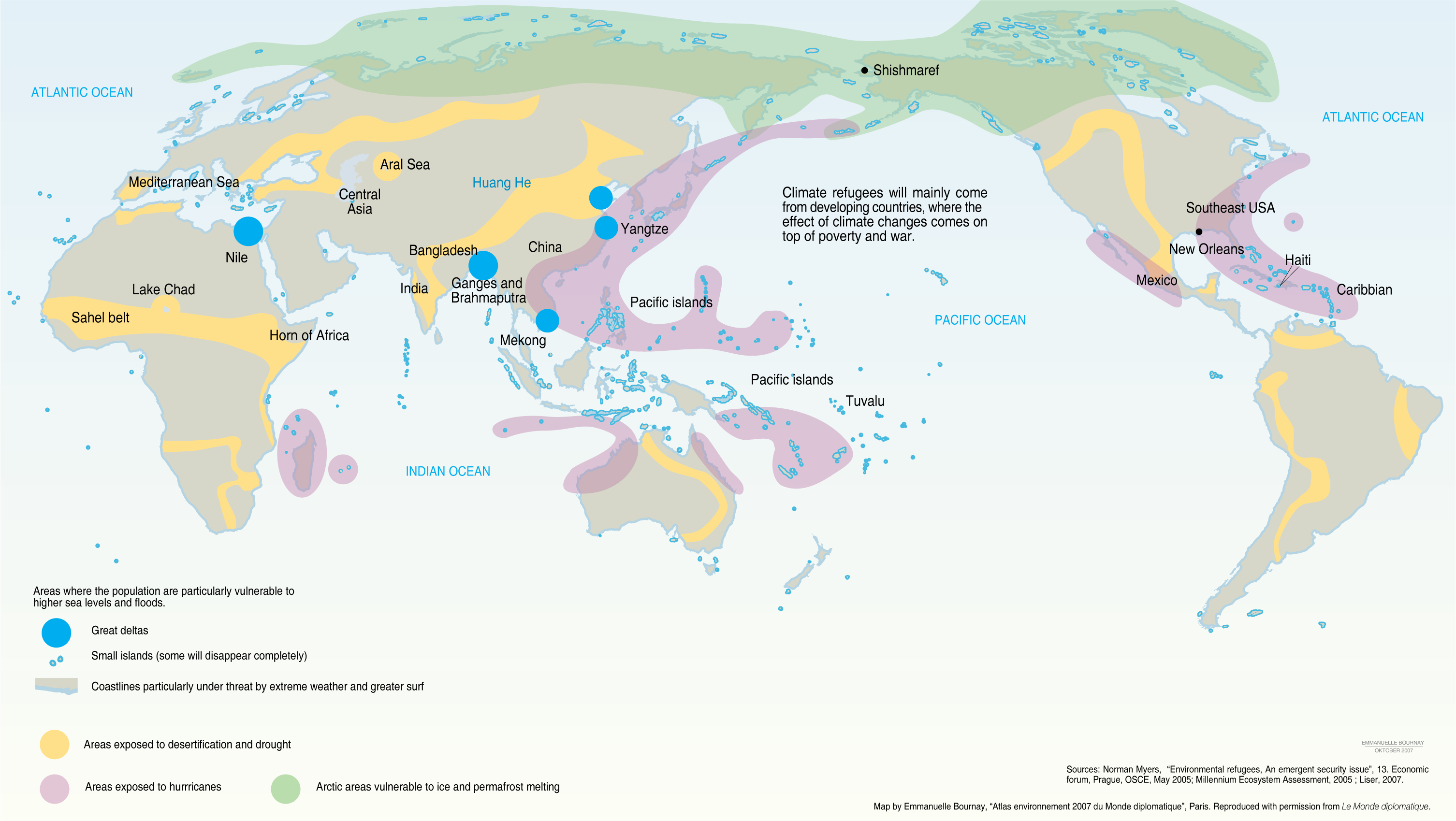
I was looking for the perfect map to show the shrinking ecumene, a map showing the extension of the oceans and of the desert. I found one which was perfect. However this map was always used by some "climate-septic". I was like, "waw, all these people are reducing the subject of my blog into pieces...". After some long hours (no more than a second in fact) of self introspection i decided to keep going with this subject. You must know why these people were criticizing this map.

The perfect map


It had been posted on the UNEP website to reinforce an article predicting 50 millions of climate refugees by 2010. Thank god, Al Hamdililah, as say the Muslims, they were not 50 millions to be displaced by extreme climatic events. The UNEP instead of commenting the difference deleted this page. Great opportunity for all the "climate septic" people who all went on the google-caches to salvage the page for their own business: septicism, explaining point by point that most of the deserts were currently greening and that the rising see level has no effects on population and that the population of the pointed area were booming.

For example, the author of one of these critics argues that the Sahelian zone had been greening from 1982 to 1999. As a proof, he points the evolution of the NDVI from an other study.
source: http://www.appinsys.com/GlobalWarming/GW_Refugees.htm
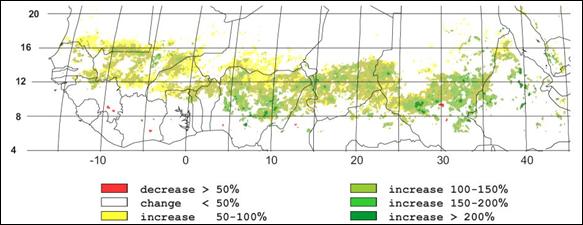
But from an other study, i can find that the evolution of the NDVI from 1981 to 2003: 
source: http://www.comap.ca/kmland/display.php?ID=298&DISPOP=VRCPR
It seems that the evolution is not really the same. These studies must work on the average of 30 years as it is convention to define a climate. Comparing two years has no interest. From now on, this argument cannot be received. Moreover, this region has hosted huge programs to fight against desertification as the "greenwall of trees". Even if the Sahel was greening, would it mean that desertification does not exist? That it is not a threat? This map is showing

Furthermore, these septic authors argue that the populations of these areas are booming as a counterexample. Should we understand that because some populations of these areas are booming, there cannot be any refugees? Of course the population is booming as many of these regions are in developing countries. 

We can easily recognize that many dramatic prevision of our future were quiet excessive. I'm thinking about the MIT which predicted the oil's end of stock for 1992, or about the "limits to growth" of 1972. But without these prediction, wouldn't we have waited until the 500£ barrel of oil to find some new oil field? Would we have imagined the sustainable development ideology? 
Also, the prediction of the UNEP were not disproportionate as today the climatic refugees are estimated around 30 millions according to the Environmental Justice Foundation. As predicted the UNEP, most of the refugees are in the least developed countries where the capacity of resilience is very low. 

To put it in a nutshell, I don't agree with the climate-septic nor in their intentions neither in their arguments. 


samedi 9 novembre 2013

A first Climatic Refugee due to climate change?

To only devote the expression "climatic refugee" to people directly affected by climate change sounds incorrect because many people had to move after some extrem climatic events. I'm thinking about the refugees of the hurricane Katrina in 2005 and about the inhabitants of L'Aiguillon-sur-mer  who had to leave definitively their house after the cyclone Xynthia in 2010.
For those two case, the question of the sea level rise comes: would the seawalls have resisted if the sea was 30cm lower? Let's considerate that these catastrophes were not due to the global warming and the sea level rise.
According to the Environmental Justice Foundation, the number of climatic refugees is three times higher than in the number of armed conflicts refugees. This number might increases fast as the IPCC predict more extrem climatic events in future.
But a new juridic status is coming into existence, at least it's for what Ioane Teitiota is fighting for with his layer Michael Kidd, specialized in Human rights. Mr Teitiota comes from the Kiribati, one of the lowest countries on earth and asks New Zealand to host him as a "climatic refugee". He argues that him and his children do not have any future possible in their country. Indeed, due to the sea level rise, the sea has already encroached upon his crops and the president of the Kiribati Island  and urges his fellow-citizens to get a degree and emigrate in a new country while being useful and not just refugees.
At the moment New Zealand has rejected twice his request. However Michael Kidd is decided to push the affair until the highest jurisdiction of the country. The last decision is crucial, it could stand for a jurisprudence for the next asylum enquirer in new Zealand and for an example in the other countries.

Cf. http://www.theguardian.com/environment/2013/may/17/climate-change-refugees-dignity-migration
      http://www.telegraph.co.uk/news/worldnews/australiaandthepacific/kiribati/10383018/Man-from-Kiribati-seeks-recognition-as-worlds-first-climate-refugee.html
      http://www.independent.co.uk/environment/climate-change/man-from-pacific-island-of-kiribati-in-bid-to-live-in-new-zealand-as-worlds-first-climate-refugee-8852083.html
      http://ejfoundation.org/node/801

lundi 4 novembre 2013

Desertification encroaching the ecumene

The ecumene is not only encroached by the sea level rise. The desertification is also an important threat for the population. Far from saying that it is not possible to settle the desert, the Gulf countries have showed us recently that towers do not need rainfalls to grow, I mean that all the human activities are not possible in the desert, especially, the most essential: agriculture. According to the FAO, two millions ha of farmland and more than 4.9 million ha of pastures are threatened by desertification. It is all the more unfortunate because the population is increasing and the consummation per capita is increasing too. The commercial farming extends its fields artificializing some natural ecosystems and making them vulnerable. For example, in Brazil, the rainforest step back in favor of the short term sugar cane plantations.
Some solutions exist against desertification.


 I let you have a look to this video from Yan Arthus Bertrand who introduces very well this threat and the solutions. Yan Arthus Bertrand is a French photographer who has observed many modifications in the landscapes over the last 30 years. He decided to sensibilize people one these questions and to lead them to sustainable behavior through his foundation Good Planet.

mardi 29 octobre 2013

Sea level rise and coastal zones

According to the article of Robert J. Nicholls and Anny Cazenave (2010), the sea level rise is due to the dilatation of the ocean (30%), the loss of the glacier (60%) and to the human activities as the ground water mining for example (10%).
More important, this article enlighten us on a very critical point. The sea level rise is not uniform over the earth. The rise of the West Pacific Ocean is three times more important than on the North American Coast. Thus, all the coasts will not pay equally the consequences of the SLR. Thus the SLR will be up to 30cm to 180cm in 2100.


The impacts on the coastal zone are the submergence and flooding of the lowest zone. Also, some intrusion of salt water in the surface waters and groundwater, but also the pressure on many coastal ecosystems as the Mangroves and the corals. These impacts will be proportioned to the relative SLR because the coast are upwelling in some regions and subsiding in some other, especially in the important metropoles multiplying the cost of societies.
 These impact will have major socio-economic consequences. Indeed the coastal ecosystems and landscapes are often a source of income for the touristic economy. The effects on tourism could be serious for many countries.

Below sea level lands in Netherlands


However, the authors are very confident in the human capacity of adaption and to their point of view, major population retreat are going to be inevitable. They use the example of the Netherlands who are already reinforcing their seawall. The Netherlands which have already many lands below the sea level have the means to act against the risks. Not all the countries have these means making them much more exposed than the Netherlands. 

Bibliography:

Nicholls, R.J. & Cazenave, A. 2010. Sea Level Rise and its impacts on coastal zones. Science. Vol. 328. No.5985. p1517-1520.  http://www.sciencemag.org.libproxy.ucl.ac.uk/content/328/5985/1517.full

jeudi 17 octobre 2013

Save the ecumene


If humans were selfish enough to not care about the protection of many mammals and their ecosystems, and silly enough to not understand that the extinction of some ecosystems could lead to their own extinction, I still hope they understand that desertification and rising oceans affect directly the human activities by reducing their “territory”: The ecumene. Indeed, the Sahara and Atacama Deserts are not the most populated place and the inhabitant of the Atlántida could attest that cities are not fully waterproof yet.

The city of Malé
To those who think a little bit more than the uneducated consumers, they will understand that to shrink the ecumene increases the anthropic pressure on the other ecosystems. Indeed, the ecumene is not only the exclusive space of humans, but a space humanity share with many ecosystems. By shriking the ecumene and given the rapid population growth, the human densities are going to jump and the pressures on the ecosystems which share the ecumene with humanity are going to explode.


According to the IPCC, the rise of the oceans will be up to 98cm by 2100. More than six hundred million people would be directly affected; corresponding to the number of people who will need to move to other cities or to other countries. In what conditions will this happen? With which consequences on the ecosystems? On the economy? On the international relations? Though this blog, I try to explore these problems.